Publications
List of my publications.
2026
-
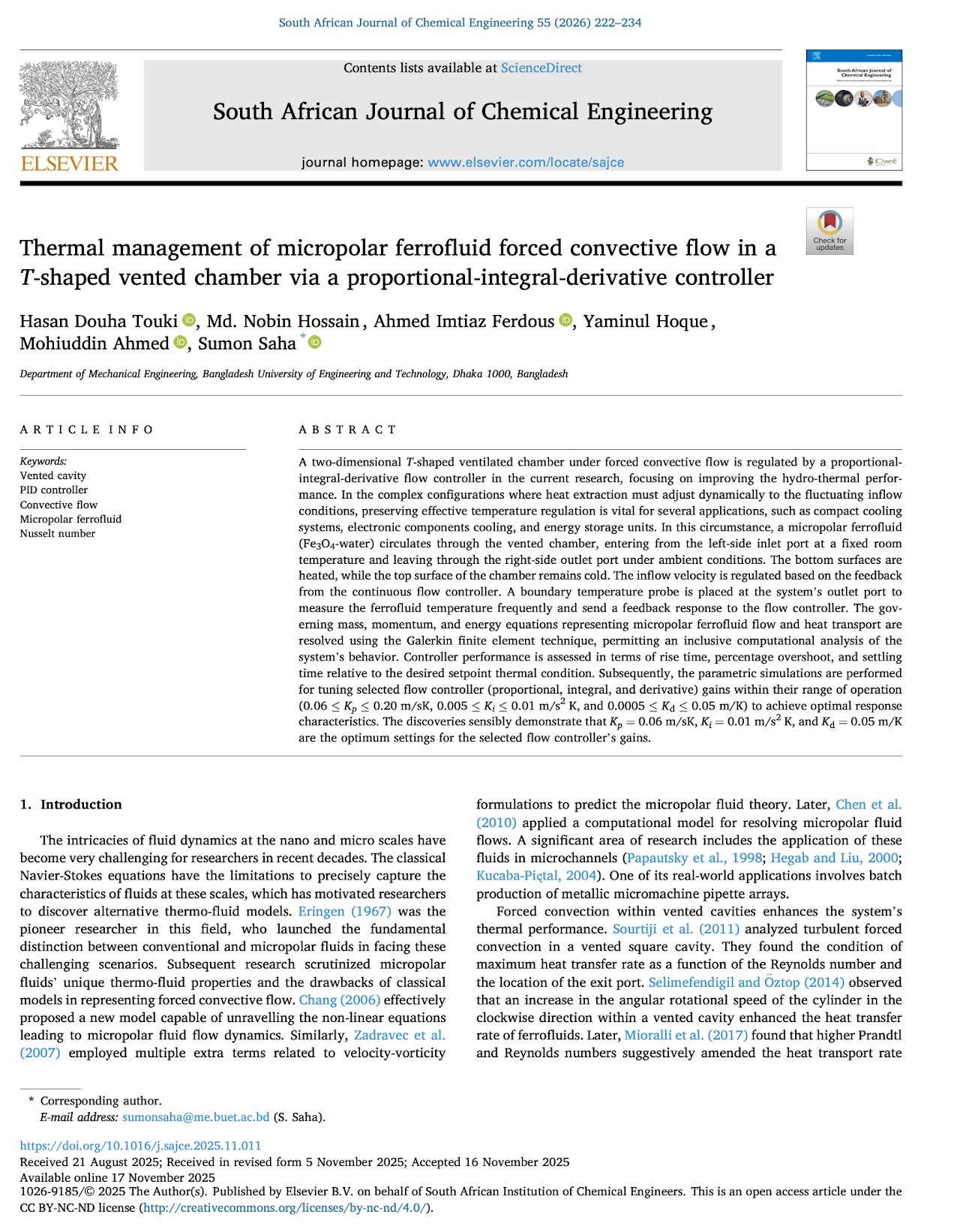 Thermal management of micropolar ferrofluid forced convective flow in a T-shaped vented chamber via a proportional-integral-derivative controllerHD Touki, MN Hossain, AI Ferdous, and 3 more authorsSouth African Journal of Chemical Engineering. Full paper can be found here , Jan 2026
A two-dimensional T-shaped ventilated chamber under forced convective flow is regulated by a proportional-integral-derivative flow controller in the current research, focusing on improving the hydro-thermal performance. In the complex configurations where heat extraction must adjust dynamically to the fluctuating inflow conditions, preserving effective temperature regulation is vital for several applications, such as compact cooling systems, electronic components cooling, and energy storage units. In this circumstance, a micropolar ferrofluid (Fe3O4-water) circulates through the vented chamber, entering from the left-side inlet port at a fixed room temperature and leaving through the right-side outlet port under ambient conditions. The bottom surfaces are heated, while the top surface of the chamber remains cold. The inflow velocity is regulated based on the feedback from the continuous flow controller. A boundary temperature probe is placed at the system’s outlet port to measure the ferrofluid temperature frequently and send a feedback response to the flow controller. The governing mass, momentum, and energy equations representing micropolar ferrofluid flow and heat transport are resolved using the Galerkin finite element technique, permitting an inclusive computational analysis of the system’s behavior. Controller performance is assessed in terms of rise time, percentage overshoot, and settling time relative to the desired setpoint thermal condition. Subsequently, the parametric simulations are performed for tuning selected flow controller (proportional, integral, and derivative) gains within their range of operation (0.06 ≤ Kp ≤ 0.20 m/sK, 0.005 ≤ Ki ≤ 0.01 m/s2 K, and 0.0005 ≤ Kd ≤ 0.05 m/K) to achieve optimal response characteristics. The discoveries sensibly demonstrate that Kp = 0.06 m/sK, Ki = 0.01 m/s2 K, and Kd = 0.05 m/K are the optimum settings for the selected flow controller’s gains.
-
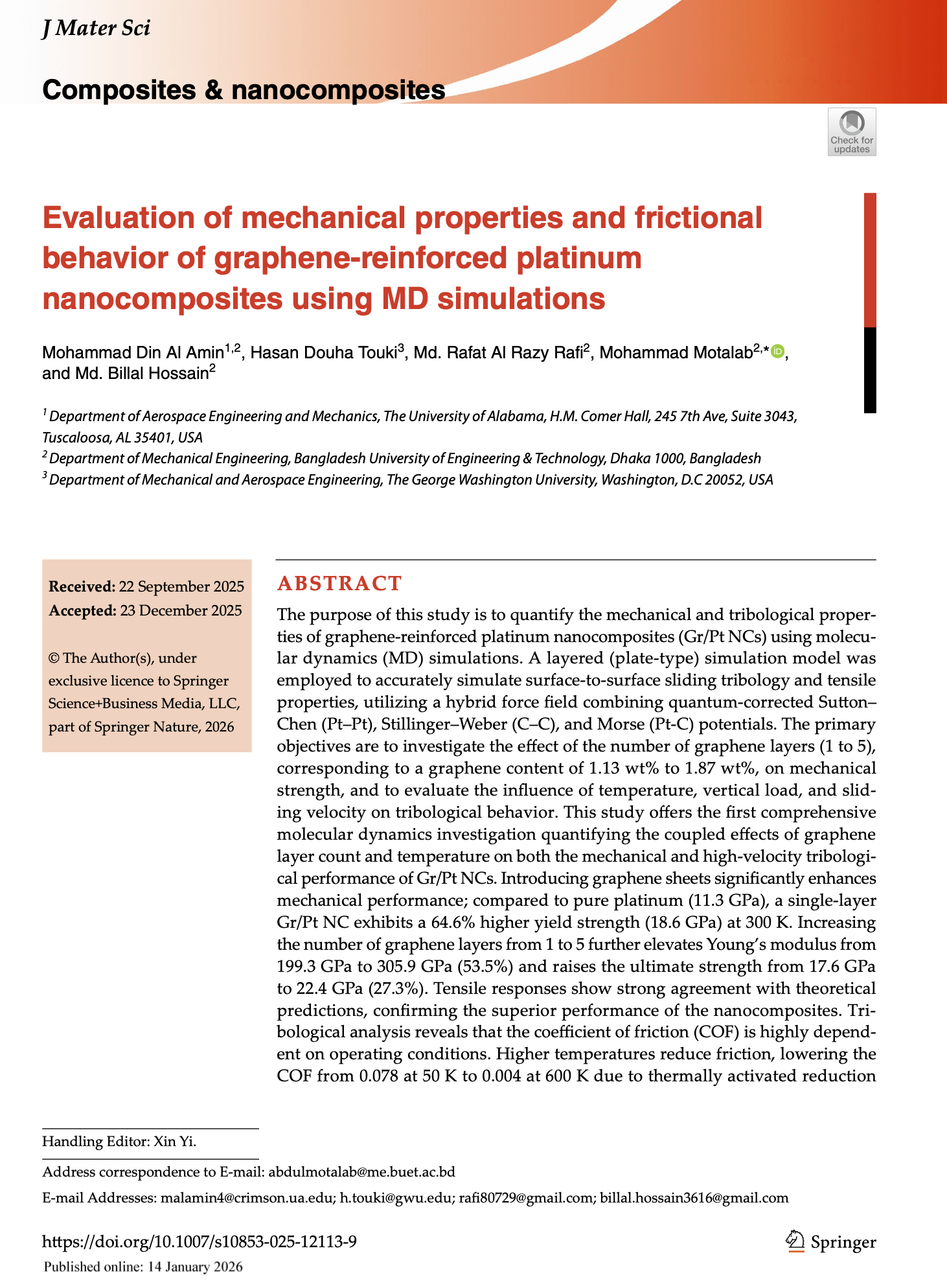 Evaluation of mechanical properties and frictional behavior of graphene-reinforced platinum nanocomposites using MD simulationsMDA Amin, HD Touki, MRAR Rafi, and 2 more authorsJournal of Materials Science. Full paper can be found here , Jan 2026
The purpose of this study is to quantify the mechanical and tribological properties of graphene-reinforced platinum nanocomposites (Gr/Pt NCs) using molecular dynamics (MD) simulations. A layered (plate-type) simulation model was employed to accurately simulate surface-to-surface sliding tribology and tensile properties, utilizing a hybrid force field combining quantum-corrected Sutton–Chen (Pt–Pt), Stillinger–Weber (C–C), and Morse (Pt-C) potentials. The primary objectives are to investigate the effect of the number of graphene layers (1 to 5), corresponding to a graphene content of 1.13 wt% to 1.87 wt%, on mechanical strength, and to evaluate the influence of temperature, vertical load, and sliding velocity on tribological behavior. This study offers the first comprehensive molecular dynamics investigation quantifying the coupled effects of graphene layer count and temperature on both the mechanical and high-velocity tribological performance of Gr/Pt NCs. Introducing graphene sheets significantly enhances mechanical performance; compared to pure platinum (11.3 GPa), a single-layer Gr/Pt NC exhibits a 64.6% higher yield strength (18.6 GPa) at 300 K. Increasing the number of graphene layers from 1 to 5 further elevates Young’s modulus from 199.3 GPa to 305.9 GPa (53.5%) and raises the ultimate strength from 17.6 GPa to 22.4 GPa (27.3%). Tensile responses show strong agreement with theoretical predictions, confirming the superior performance of the nanocomposites. Tribological analysis reveals that the coefficient of friction (COF) is highly dependent on operating conditions. Higher temperatures reduce friction, lowering the COF from 0.078 at 50 K to 0.004 at 600 K due to thermally activated reduction of adhesive interactions. Although higher vertical loads increase friction force, the COF decreases, indicating an adhesion-dominated nanoscale regime. Sliding velocity also plays a critical role; increasing velocity from 50 m/s to 200 m/s raises the COF from 0.43 to 0.99, with wear initiation observed at 200 m/s. These findings quantify the superior mechanical strength and tunable frictional characteristics of Gr/Pt NCs relative to pure platinum.
2025
-
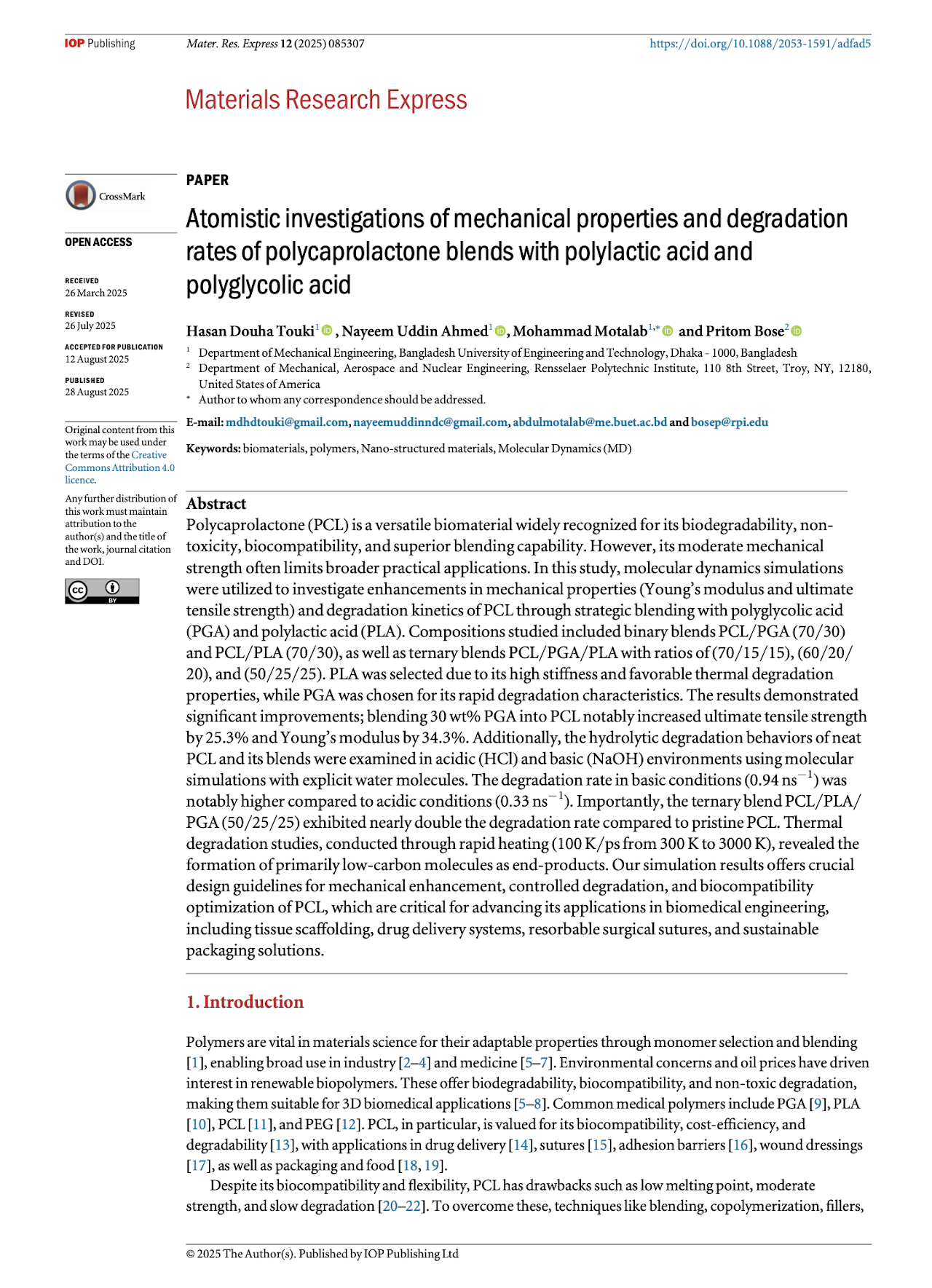 Atomistic investigations of mechanical properties and degradation rates of polycaprolactone blends with polylactic acid and polyglycolic acidHD Touki, NU Ahmed, M Motalab∗, and 1 more authorMaterials Research Express. Full paper can be found here , Aug 2025
Polycaprolactone (PCL) is a versatile biomaterial widely recognized for its biodegradability, non-toxicity, biocompatibility, and superior blending capability. However, its moderate mechanical strength often limits broader practical applications. In this study, molecular dynamics simulations were utilized to investigate enhancements in mechanical properties (Young’s modulus and ultimate tensile strength) and degradation kinetics of PCL through strategic blending with polyglycolic acid (PGA) and polylactic acid (PLA). Compositions studied included binary blends PCL/PGA (70/30) and PCL/PLA (70/30), as well as ternary blends PCL/PGA/PLA with ratios of (70/15/15), (60/20/20), and (50/25/25). PLA was selected due to its high stiffness and favorable thermal degradation properties, while PGA was chosen for its rapid degradation characteristics. The results demonstrated significant improvements; blending 30 wt% PGA into PCL notably increased ultimate tensile strength by 25.3% and Young’s modulus by 34.3%. Additionally, the hydrolytic degradation behaviors of neat PCL and its blends were examined in acidic (HCl) and basic (NaOH) environments using molecular simulations with explicit water molecules. The degradation rate in basic conditions (0.94 ns−1) was notably higher compared to acidic conditions (0.33 ns−1). Importantly, the ternary blend PCL/PLA/PGA (50/25/25) exhibited nearly double the degradation rate compared to pristine PCL. Thermal degradation studies, conducted through rapid heating (100 K/ps from 300 K to 3000 K), revealed the formation of primarily low-carbon molecules as end-products. Our simulation results offers crucial design guidelines for mechanical enhancement, controlled degradation, and biocompatibility optimization of PCL, which are critical for advancing its applications in biomedical engineering, including tissue scaffolding, drug delivery systems, resorbable surgical sutures, and sustainable packaging solutions.
-
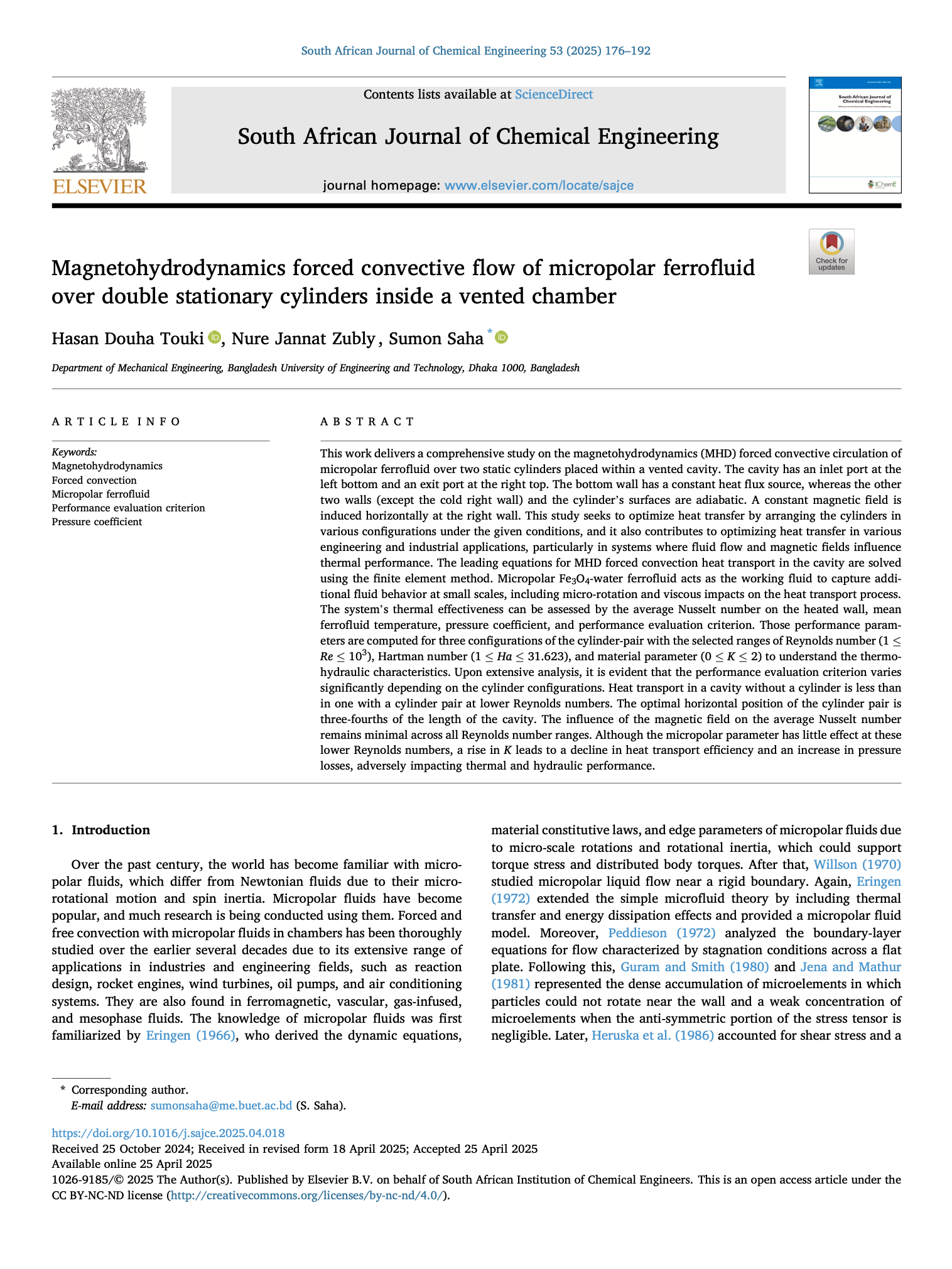 Magnetohydrodynamics forced convective flow of micropolar ferrofluid over double stationary cylinders inside a vented chamberHD Touki, NJ Zubly, and S Saha*South African Journal of Chemical Engineering. Full paper can be found here , Jul 2025
This work delivers a comprehensive study on the magnetohydrodynamics (MHD) forced convective circulation of micropolar ferrofluid over two static cylinders placed within a vented cavity. The cavity has an inlet port at the left bottom and an exit port at the right top. The bottom wall has a constant heat flux source, whereas the other two walls (except the cold right wall) and the cylinder’s surfaces are adiabatic. A constant magnetic field is induced horizontally at the right wall. This study seeks to optimize heat transfer by arranging the cylinders in various configurations under the given conditions, and it also contributes to optimizing heat transfer in various engineering and industrial applications, particularly in systems where fluid flow and magnetic fields influence thermal performance. The leading equations for MHD forced convection heat transport in the cavity are solved using the finite element method. Micropolar Fe3O4-water ferrofluid acts as the working fluid to capture additional fluid behavior at small scales, including micro-rotation and viscous impacts on the heat transport process. The system’s thermal effectiveness can be assessed by the average Nusselt number on the heated wall, mean ferrofluid temperature, pressure coefficient, and performance evaluation criterion. Those performance parameters are computed for three configurations of the cylinder-pair with the selected ranges of Reynolds number (1 ≤ Re ≤ 103), Hartman number (1 ≤ Ha ≤ 31.623), and material parameter (0 ≤ K ≤ 2) to understand the thermo-hydraulic characteristics. Upon extensive analysis, it is evident that the performance evaluation criterion varies significantly depending on the cylinder configurations. Heat transport in a cavity without a cylinder is less than in one with a cylinder pair at lower Reynolds numbers. The optimal horizontal position of the cylinder pair is three-fourths of the length of the cavity. The influence of the magnetic field on the average Nusselt number remains minimal across all Reynolds number ranges. Although the micropolar parameter has little effect at these lower Reynolds numbers, a rise in K leads to a decline in heat transport efficiency and an increase in pressure losses, adversely impacting thermal and hydraulic performance.